
The Resilience Factor
How Challenges Shape our Well-being.
Written by Mari Ebersole.
Life is hard.
The human experience is to encounter suffering. This is not something to be discouraged by, but something to be accepted as a simple fact. For example, many young people have conflicting desires for “the future” and struggle to decide on a career path. On the one hand, if we choose not to work hard and neglect our goals, we may be left with the feeling of regret and shame. That is hard. On the other hand, if we work diligently to afford certain luxuries in life, that may also be at the expense of other pleasures – which is also hard.
No matter what path we go down, adversity is guaranteed. The term “work-life” balance is a scam that will only make you feel bad about yourself, no matter what end of that spectrum you may fall on. And outside the aspects of professional trials, as humans, we are destined to experience loss, heartbreak, discomfort, and sadness. These are foundational human experiences.
I’ve been thinking a lot about what types of challenges I’ll face in the near or extended future. As a rising senior in college, there’s a lot on the table regarding career choices, financial decisions, further education, where I’ll live, and more. Many of us in the alumni network are navigating a dynamic period in our lives; it’s often hard to know what’s “right.” Amidst these decisions, I have often found myself going with what’s “easiest” and have been disappointed with the outcome. I have found myself losing sight of the fact that the choices I make directly impact the quality of my life and future circumstances. Recently though, finding ways to address my fear has been mentally and physically transformative in helping me navigate my goals, manage my anxiety, and improve my overall wellness.
Coming to terms with the fact that our decisions are ours is challenging, but must be done. As young leaders working to positively impact our communities, we are the architects of the future. If we experience adversity or even bad luck, we can’t blame “society,” or any external force, for that matter. Placing the blame on external parties takes us out of the driver's seat, leaves us as bystanders in our own lives, and won’t change reality. It can be frightening knowing that as individuals who seek to contribute to society, we create our circumstances. Although frightening, knowing we are in control of our future is compelling and empowering. Sure, there are things in life we can't control, but we have authority over far more things than we think. This gives us the ability to make this world a better place just by reclaiming that power as ours.
Let’s unpack this a little. Sure, not everyone is dealt an equal hand in life. Some people are faced with adversity from the day they come out of the womb. Other people seemingly have it “easy” and are granted certain privileges. But as humans, we will still face hardships in one form or another. In my life, it has been empowering to stop comparing my life to someone else’s life and realize that even the “strongest” person I know has probably wondered if they would even make it through the day, and didn’t see the light at the end of the tunnel. I’ve certainly felt that way too! That’s life – it’s not something to feel bad about.
I know my life and moving forward, I’m committed to accepting challenges. Even though that sounds corny, it’s the truth. I think that in order to thrive and be mentally and emotionally healthy in this world, we have to be committed to that and stay resolute. The alternative may lead to great suffering. I am determined to embrace that which is hard, and live presently each day. I’m not saying everyone needs to “push through” their issues and struggles, but rather that even the strongest people who you think never go through the same struggles as you, have it hard in one way or another. As I realize that life will have challenges and setbacks, I also realize I might as well accept it, embrace it, and take action to make sure I’ll remain resolute in the trials I face. My mind, body, and soul will be in it for the long haul.
Accepting life's challenges with resilience and determination not only strengthens our mental and emotional well-being but also nurtures our physical health. For me, understanding that my mental and physical states are intimately connected was certainly something that motivated me to change my outlook on life, and inspired me to not only accept that I will encounter obstacles in life, but to also take action that I believe in. Physical and mental resilience is something I strongly believe in, as it instills a sense of confidence and pride, which can help us maneuver through trials in life. By exploring the connection between accepting life's challenges and its benefits on physical health, we can discover the potential for growth, strength, and improved overall well-being.
Our Minds and Bodies
Impactful on my journey to understanding the vital connection between our mind and bodies was, Dr. Deepak Chopra, a medical doctor turned monk who is considered a guru in modern wellness. This quote from Dr. Chopra describes it better than I could:
“The wellbeing of an organism consists of healthy cells functioning without falling into dysfunction. Dysfunction is a dry-sounding term, but once the life of the cell starts to go awry, it’s only a matter of time before the whole body is affected, resulting in pain, discomfort, illness, and a general decline from wellbeing. The brain operates through cells like any other organ, and neuroscience now has abundant evidence that psychological states like anxiety and depression have physical correlates in brain cells.
If we equate happiness with wellbeing, which seems only logical, then addressing the optimal functioning of cells is crucial. Cells are constantly sending and receiving messages that impact how you think, act, and feel. There is a never-ending conversation between you and the trillions of cells in your body. This conversation can be described as a feedback loop in which input is sent to and from each cell, which in turn responds with output. These are widely accepted concepts in biology, neuroscience, physiology and medicine.
The upshot is that if you give your body positive input, it will respond with positive output, leading to a state of wellbeing. As you develop habits and routines, the neural circuitry in your brain and activity of your gene networks will reflect them, for better or for worse with respect to your health, happiness, and wellbeing. Input and output are terms lifted from cybernetics; in human terms the kind of input involved in everyone’s daily life includes:
Food, air, and water
Mental activity, including thoughts, feelings, images, and sensations
Physical activity
Sleep
Relationships
Exposure to outside stresses, including everyday demands and challenges
Because all these ingredients boil down to biochemicals, as far as your cells are concerned, the input and output of your genes turns out to be radically important. Your genes are responsible for regulating the life of the cell. DNA is where the buck stops.
So the age-old question of how to be happy may depend, surprisingly enough, on ‘talking’ to your genes in a positive way, which means self-directing your own biology.”
You can choose to agree or disagree with Dr. Chopra’s work. However, recent research by the CDC has indicated that rates of chronic pain diseases are higher than ever and that an estimated 20 percent of adults suffer from chronic pain. According to the CDC, the leading causes of death in Hawaiʻi are cardiovascular disease, cancer, and stroke. And according to the World Health Organization, mental health conditions are increasing worldwide. There was a 13 percent rise in mental health conditions and substance use disorders between 2007 and 2017, with mental health conditions now affecting nearly 20 percent of the world’s population. On top of that, in the past 3 years, millions of people across the world have suffered because of the devastating COVID-19 pandemic. While these incidences are not related, they should be considered shared experiences, as they have significant impacts on public health. We must recognize our personal responsibility to best manage and reduce these risks for ourselves.
This is especially important in Hawai’i which is considered a medical desert, meaning that access to medical care is limited on the island. While it isnʻt the sole responsibility of the individual to solve this systemic issue, we must also understand our own stake in this issue and position ourselves to best respond given the circumstances.

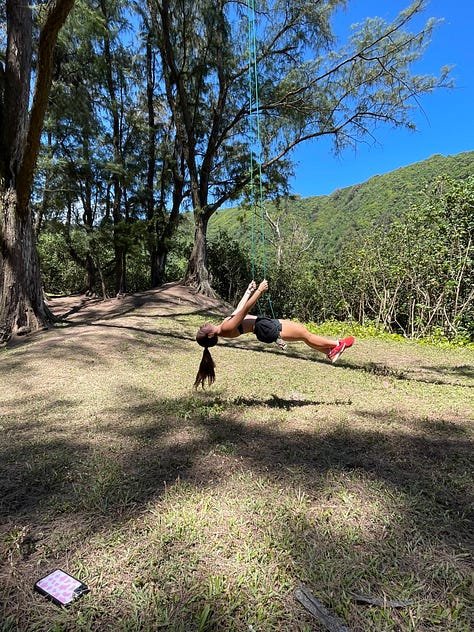

In Hawaiʻi, we have amazing opportunities to get out in nature to better our health. For example, going out on a hike, getting some sun, or being at the beach are all examples of activities that can uplift your spirit to perhaps inspire a lifestyle transformation from the inside out. These little things can help make life’s challenges a little more manageable. For me, it’s helped tremendously with minimizing feeling like I’m treading water just to make it through the day.
Let’s thrive — our lives literally depend on it. Life is not perfect, but that's what makes it fun! Yes, we will all experience struggles. But I find comfort in knowing I am not isolated in this experience. And as we navigate life’s ups and downs, we must be assured in our agency. While it can be difficult to develop that mindset, knowing I have the power to self-direct my own well-being has been empowering and transformative for my physical and mental health … I hope it can be for you too. Stay well, my friends.