

The 5Ws (+H) of Work
"What do you want to do with your life?" is often the first question that we ask ourselves when considering our futures.
Written by Melissa Newsham (O'Rourke).
Many of us find ourselves in a transition phase of life, moving from the realm of “what if” to “what is.” Some of us have already completed our journey of higher education and have been independent adults for a considerable time now. Others may be on the brink of stepping into the “real world” or perhaps have just recently taken that step. Regardless, the pursuit of meaningful work is sure to occupy a large portion of our minds.
In my case, I recently graduated from college in December and started a full-time job in February. So, please take my thoughts for what they are — mere reflections about work from someone who has just entered the workforce. It’s not meant to be a manifesto of some sort or an attempt to dictate the trajectory of your life. Instead, I hope there is something in my effort to organize these jumbled thoughts that you find helpful or at least interesting.
Unlike many areas of life where I firmly believe in straightforward rights and wrongs, I think the domain of work is deeply personal. I have observed and taken part in unnecessary judgment and comparison. Determining the right work for you is an individual endeavor shaped by a multitude of factors. To help organize my thoughts, I used the 5Ws (plus an H) framework that most of us encountered when we learned to write. This structure helped me to process and arrange my seemingly disparate thoughts about work.
Who
When operating in the purely hypothetical realm, it feels like the sky is the limit. It’s difficult to assess the pros and cons when they’re not right in front of us. But many of us have had the experience of realizing our career ambitions don’t match up with our natural gifts — or lack thereof. There are real limitations to what we can achieve, and these constraints become more apparent to us as we mature and edge closer to entering the workforce. Once the obvious limitations weed out the entirely impractical options, our interests and life priorities become more crystalized. In other words, we begin to know ourselves better.
One of my concerns, in retrospect, is that society often prescribes a one-size-fits-all approach to work. There are certain types of jobs that are regarded as being respectable and that really “mean something.” What if you wanted to enroll in a trade school? What if you wanted to be a homemaker? These options are often looked down upon and regarded as lesser choices.
However, the right “what” for you depends on who you are. What are your priorities? What are your passions and values? What do you derive meaning from? What excites you? What is your stress tolerance? Before charting out ambitious 10-year plans, we ought to spend time analyzing our priorities, strengths, and goals.
When
Historical Context

Taking time for self-reflection is vital — and easy. After all, we all spend a heck of a lot of time thinking about ourselves. However, we should also broaden our perspective beyond our immediate personal realities. The fact that we can even discuss our strengths or gifts in the context of a paid job is quite a remarkable development in the vast tapestry of time. For instance, if you were a male living in rural Pennsylvania in the 19th century, you had two career options: either become a talented coal miner or a less talented coal miner. For most of human history, people did not have the luxury of chasing their passions or wielding their strengths toward their ideal careers. Most people probably didn’t spend much time “soul-searching” or figuring out who they are before deciding which vocation to pursue. This reality remains true for billions of people alive today.
By and large, we are afforded many more options than were available in the past. We find ourselves inundated with choices, akin to the surge in streaming options available today compared to even a decade ago. We have thousands of movies and shows available at our fingertips. On the one hand, this feels like an upgrade from times past when only a handful of options were available. However, the abundance of options often leaves us feeling overwhelmed, and we spend half an hour figuring out what to watch and end up choosing a crappy option anyway.
Due to the sheer amount of potential alternatives, the grass always seems greener on the other side. I think having a broader perspective of history can help alleviate anxiety or stress over figuring out the “right” path.
Age
Another facet of “when” pertains not to our place in the course of history, but to the stage of our life. Our priorities, goals, and capacity in our 20s probably look different than they will in our thirties and beyond.
One obvious, yet often ignored aspect of age is the question of fertility. While this discussion will ruffle a few feathers and provoke some discomfort, I think it’s worth at least mentioning. While this topic could be an article of its own, I will keep it short here.
Career achievements are certainly important. However, many people have additional aspirations — like starting a family. I think women and girls are often sold a lie regarding fertility: that we shouldn’t worry about it and that technology and science have made having children in your late 30s and into your 40s easy. I, too, held this belief until a few years ago.
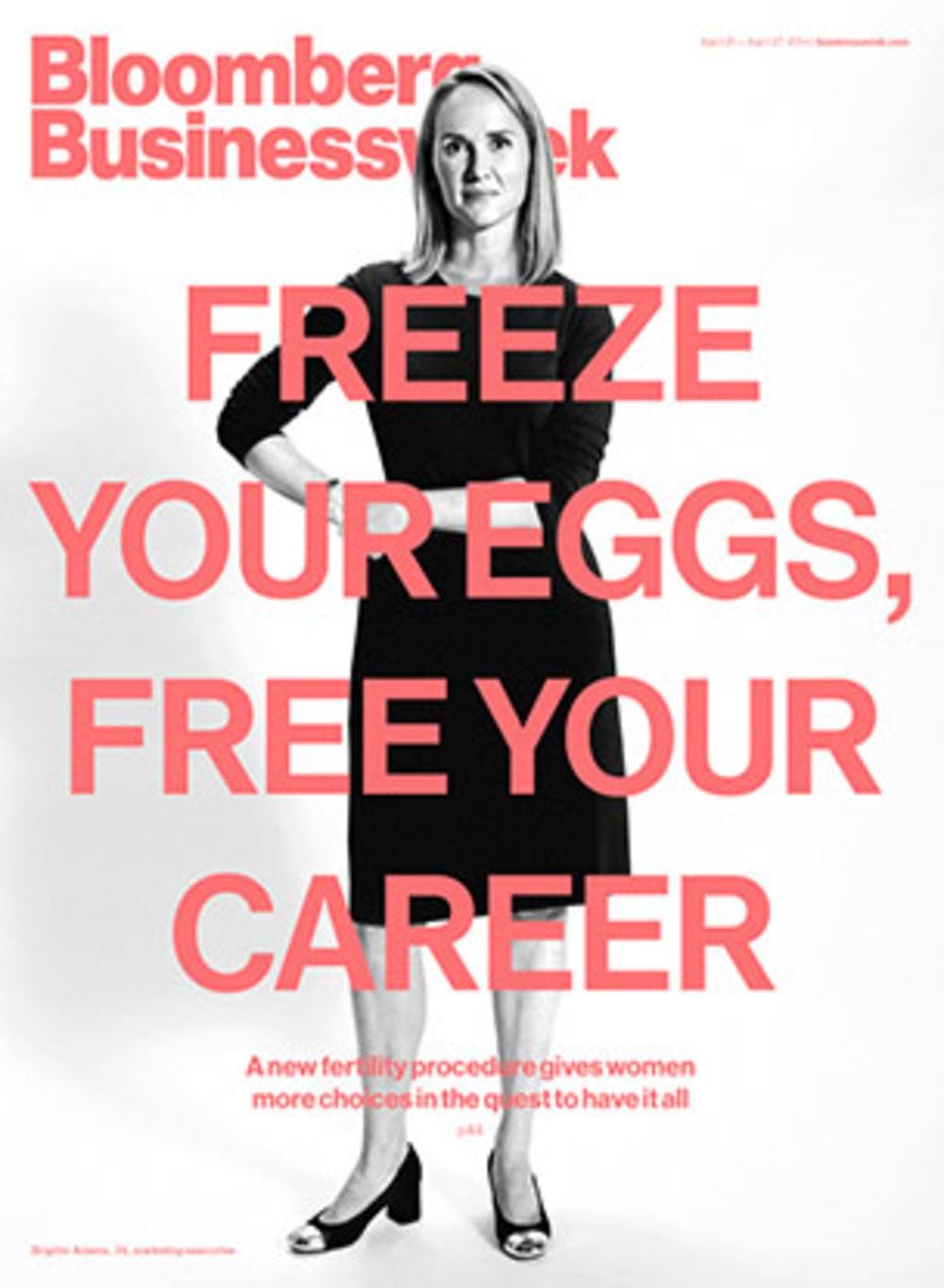
But the story of Brigitte Adams serves as an illustration of how things are not that simple. In 2014, she appeared on the cover of Bloomberg Businessweek with a headline that read, “Freeze your eggs, Free your career: A new fertility procedure gives women more choices in the quest to have it all.” Brigitte had spent tens of thousands of dollars in her 30s to freeze and store her eggs. But tragically, as this 2017 Washington Post article described, all of her eggs failed to produce a pregnancy.
As humans, we often desire to “have it all” without having to make any sacrifices. Yet, that’s not reality. There are tradeoffs in every decision we make. Life is filled with competing interests; it’s a war between different priorities. Many women are making sacrifices without even realizing that they are making them, resulting in deep regrets and heartbreak down the road.
There is something nefarious about misleading people about something as fundamental to the human experience as fertility and reproduction. What individuals choose to do with their life — whether that’s climbing the corporate ladder, dedicating themselves to community service, or starting a family — is their choice. But I think we should at least be aware of the tradeoffs we are making, and be able to make informed decisions accordingly.
Where
The “where” is perhaps the most controllable aspect of our work in the sense that we essentially choose to live wherever we’d like. At the same time, this decision is a complex one, influenced by pragmatic considerations like job opportunities, average salaries, or cost of living.
For many of us, we have a very specific “where” in mind. Many of us desire to live and work in Hawaii regardless of the cost or sacrifices involved. Others share the desire, but competing priorities impede or delay the aspiration from becoming reality.
Though the primary focus of this piece isn’t centered on Hawaii or its specific cost of living issues, it’s worth noting that Honolulu had the lowest monthly average starting salary when adjusted for cost of living among 180 major U.S. cities recently surveyed. Stats like these underscore the serious challenge in advocating for Hawaii as an easy place to start a career, even for those who prioritize pay to a lesser extent. Balancing dreams with practicality is a universal concern. My hope is that Hawaii can transform from a “dream” location to a practical and attainable place for more of us to call home too.

Why: A necessary evil or everything?
At one end of the spectrum, there is the idea that work is a necessary evil and a mere means to survival. There is a growing sentiment that work itself is an injustice and that humans are entitled to essentials like food, water, and shelter without the need to work. Now, the idea that humans should be able to subsist without effort is ridiculous on its face. For example, who produces the food that everyone is supposedly entitled to? Who builds the shelters in this utopia? I admit that I perhaps once thought that in the perfect world — in heaven — there would be no work and all leisure. I had overlooked how God commanded humans to “fill the earth and subdue it,” and that He himself engaged in the work of creation. Of course, there are disordered types of work on this side of heaven, but it is not a necessary evil. Work is good.
However, knowing the audience of this piece, likely very few of us, if any, hold the belief that work is inherently bad. On the contrary, I think many of us are susceptible to the notion that our jobs are the reason for existing. We equate work to life itself and view a job as not something that we do, but something that we are. Certainly, a job can provide a profound sense of purpose and the opportunity to steward our talents for good. But it’s not everything.
Every job presents its own challenges. Hence, having a purpose for your work is essential. The underlying “why” doesn’t necessarily have to be to change the world, though it very well might be. It could be because you find it personally fulfilling; because it allows you to give back to your community; or because it allows you to provide for your family. You could derive meaning and purpose from the job itself, or the opportunities it opens up in your personal life. Regardless, there should always be an underlying motivation behind what we do. And hopefully, it can be greater than, “Because I have to.”
What & How
“What do you want to do with your life?” is often the first question that we ask ourselves when considering our futures. However, the “what” is not an independent consideration; it’s shaped by the Ws mentioned above (and a swathe of other variables not discussed). The preceding sections hopefully offered some ideas for you to chew on regarding how we might approach thinking about work.
Identifying our calling, or the “what,” is indeed a significant endeavor, and one that warrants careful consideration. However, I think we often assign too much moral weight to the “what” rather than the “how.” We tend to elevate individuals in certain positions, deeming them morally superior and inherently virtuous — particularly those in high positions of power and influence. There’s a tendency to regard their work, and by extension, themselves as being more valuable. Those who have the audacity not to pursue climbing the corporate ladder or those who haven’t missed their kids' recital or two are lazy and unambitious. On the flip side, those of us comrades from a particular political tradition tend to exalt laborers and the so-called “working class,” albeit only a particular segment of them (in my opinion).
To be clear, I am not suggesting that the “what” doesn’t matter. Some roles demand tremendous bravery, sacrifice, or risk-taking. Some jobs are so inherently arduous and unpleasant that those who perform them deserve utmost respect — like the saints who pick up the garbage in the alley behind my apartment building which resembles something out of a third-world country.
The truth is, the vast majority of jobs are not glamorous; they are not particularly remarkable, and those occupying those positions will not be written about in history books as having accomplished something extraordinary. Nor are most jobs so miserable that those engaging in it deserve to be praised by virtue of filling those positions.
Nevertheless, the vast majority of work is good; whether that’s a corporate career, manual labor, public service, starting your own business, or homemaking. Most jobs (I say most because I believe some “jobs” are purely destructive) are fulfilling the mandate to “subdue the earth.” What you are doing is not always a matter of moral character, but whether or not you choose to do things with excellence is.
The question of, “What am I doing with my life?” will undoubtedly occupy a significant portion of our thoughts. Since graduating and entering full-time work, I’ve often asked myself this question. The answer may not be crystal clear. In the meantime, perhaps we can find satisfaction and fulfillment in how we choose to approach the tasks before us and worry less about the “what.”
The key term here is “worry.” After all, if we seek to be leaders and effect meaningful change in our community, we ought to be thoughtful and intentional in our actions. But we can’t let overthinking paralyze us. Nor should we let lofty ambitions eclipse our willingness to do mundane and menial things with integrity. The “right” job will not always be easily discernible, but one thing we can be certain of is that striving for excellence in everything we do is always the right thing. If we strive to do that, I think we’re on the right track.